
Schedules can prove to be very helpful for a business that needs inbound calls to their numbers to point to different targets at different times.
- With no schedule set, what you have programmed in the menu "Inbound Calls Handling" will be the inbound target for your number 24 hours a day, 7 days a week.
If you need a schedule, please see below for an example of how to set one up.
Here is a common scenario we will use for creating a schedule :
Your business has two Automated Attendants, one for Open Hours, and one for After Hours.
Noted below is your schedule you have in mind:
| When? (Day of week, hours) | Where does the call need to go ? |
| Monday-Friday 9am to 5pm | Ring Open Hours Automated Attendant |
| All other times during the week | Ring After Hours Automated Attendant |
Guide & Template
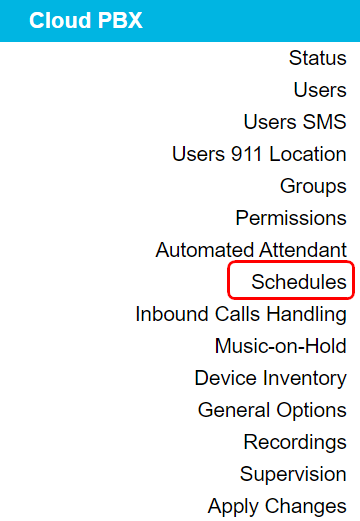
Once you have created your two Automated Attendants, head to "Cloud PBX" - "Schedules":
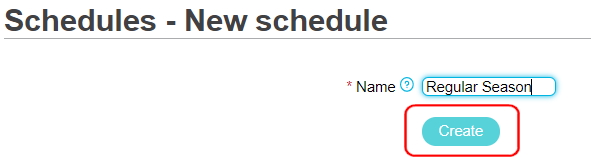
Next, give your Schedule an identifiable name and click "Create"
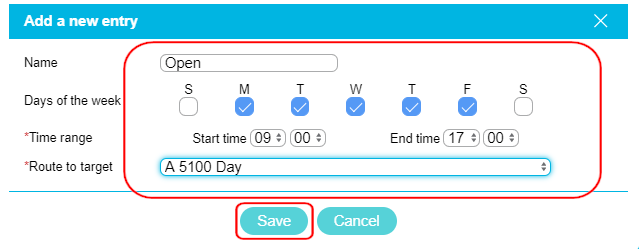
- Click "New Entry"
- Give it name and check off the days and set the hours you want. (You must use 24 hour clock for the time range!)
- Choose as a target, the automated attendant A5100 Day. Click Save.
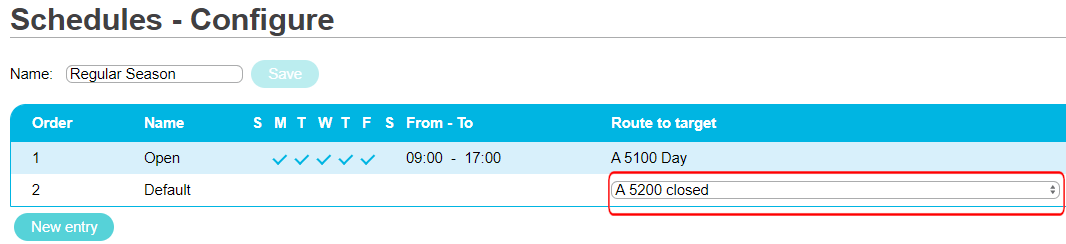
Next there is an entry called "Default", which corresponds to "any other time not specified".
- So far you have specified what happens between 9h-17h Mon-Fri.
- So the target for "default" will be reached, only if it is not between 9h-17h Mon-Fri.
- Set the Default Target to "A5200 Closed"
Next, you will need to point your number to your Schedule, otherwise it will not be active.
Go to "Cloud PBX" - "Inbound Calls Handling"
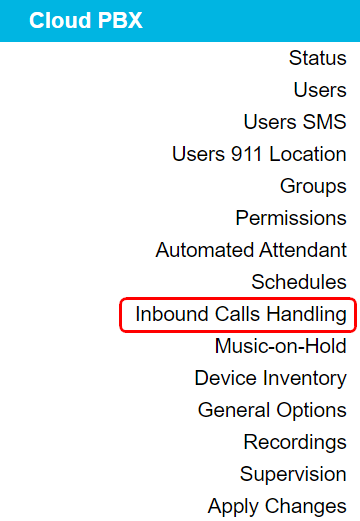
Beside the number, and under the column "Route to", select "S5012 Regular Season" (or whatever name you chose).

Then, go to "Cloud PBX" - "Apply Changes", and click "Provision".
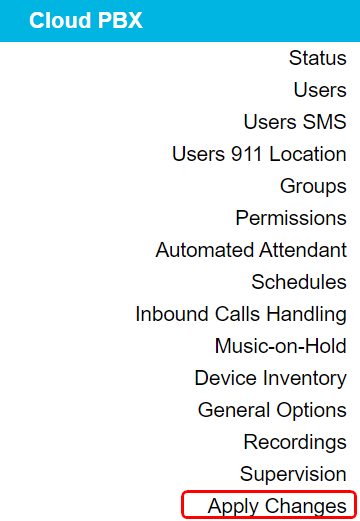
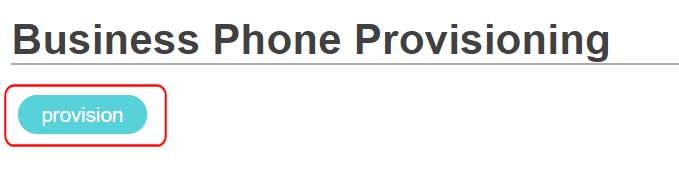
That's it, your schedule is now up and running!
Note: If you would prefer a more flexible routing where you can change modes from "day" to "night" with a star code or programmed key, the solution is to use our Night mode programming.
Click here to learn how use the Night mode feature.